Overall Concept
- Install and operate in-situ, low-cost, stand-alone, electronic sensing nodes in close collaboration with post-project operating entities, having a real interest from local communities, including the commercial sector, offering a clear sustainability and commercialisation path beyond the project’s duration.
- Establish a low-cost and sustainable network of electronic sensing nodes in under-sampled desert areas and ecosystems in Egypt, Serbia and Spain.
- To develop data processing services based upon ICT infrastructure that allows to gain access to data from hard-to-reach, under-sampled areas, and further improve their quality by data fusion services.
- Provide data for the research community, aiming to enhance climate change models and further support the research for the European Green Deal challenges; this includes the development of better dust particle movement models and increase the understanding of dust movement towards the European territory, as well as providing Renewable Energy S Planning and Ecosystem Management services.
- Cross-COPERNICUS ecosystem integration Abrupt fragmentation thresholds of eight zonal forest types in mainland Spainand assimilation.
Assessment and monitoring of land condition in the Iberian Peninsula, 1989-2000
- Accelerate the adoption of the CiROCCO tools and services by the wider community to ensure impact maximisation.
.png)
Overall Concept
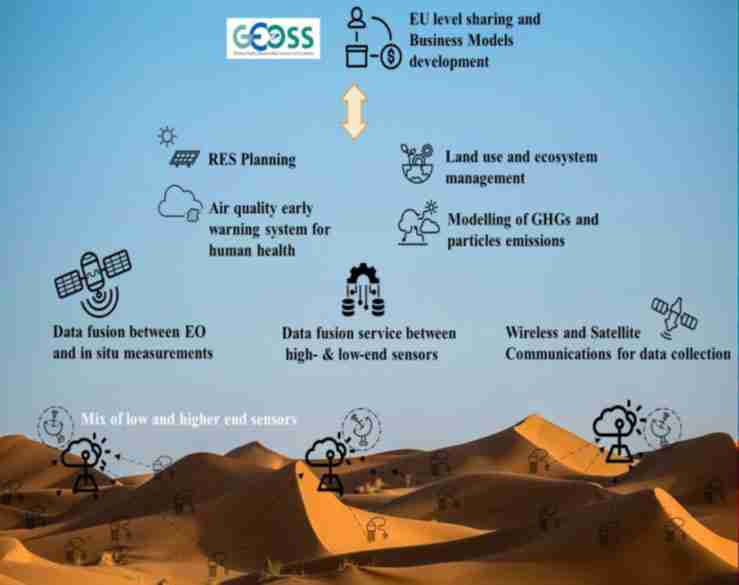 CiROCCO aims to collect data from low-cost, stand-alone, electronic sensing nodes, in addition to higher-quality, off-the-self, sensing stations and medium-cost portable sun photometers through mobile monitoring campaigns. The collected data are fused with remote sensing data and further analysed. A mixture of wireless communication means including satellite, and local Wireless Sensor Networks is used for the collection of data. A series of services are developed, based on the needs of the local communities, as presented in Figure 1, namely:
- Renewable Energy Systems planning
- Air quality early-warning system for human health
- Land use and ecosystem management
- Modelling of Green House Gases and particles emissions, to validate the quality of the collected data and drive the sustainability and exploitation path of the overall system.
CiROCCO Methodology
CiROCCO will install the same sensing nodes and data collection equipment in all the areas covered, aiming to produce consistent time-series data in a standardised way. The CiROCCO system will demonstrate how an extended network infrastructure (supplemented by LoRaWAN and satellite communicationss) can be used to transmit data from sensors in hard-to-reach areas to the central monitoring system. Multiple nearby stations can be connected to WiFi, Bluetooth, Zigbee, LoraWAN networks, where an edge device aggregates data, pre-processes it and transmits (either raw or pre-processed) using 4G or radio waves depending on the network coverage, data to other existing platforms and monitoring services. To retrieve data from the edge device, the satellite Internet of Things network from consortium partners will be employed. All the data will be treated in the Stream Handler Platform offered by the consortium partners.
This platform provides the hooks for interconnecting, storing, transforming and processing data, as well as training, validating and executing Machine Learning and Deep Learning algorithms, resulting to a full Big Data solution with AI Capabilities. It is a high-performance (low latency and high throughput) distributed streaming platform for handling real-time data based on Apache Kafka, and it can efficiently ingest and handle massive amounts of data into processing pipelines, for both real-time and batch processing. The Stream Handler Platform and its underlying technologies can support any type of data-intensive ICT services (Artificial Intelligence, Business Intelligence, etc.) from cloud to edge.
The selection of a suitable low-cost sensor that can actually capture the variability of the targeted environmental parameter is a crucial first link in the chain of validated sensor data generation. In the framework of CiROCCO, this decision is highly relevant for the air quality parameters. Particulate Matter (PM) is the main air quality output that corresponds to the design and objectives of the project. Given that the focus is placed on desert areas, it is consequential that coarse dust particles have to be measured, thus requiring the ability of the low-cost sensors to sample and quantify PM10 particles along with smaller size fractions (e.g., PM2.5). Coarse dust particles transported from desert areas are considered a major issue for the attainment of the EU PM10 standard, especially in Southern European countries, and there are specific provisions for the identification and exclusion of such events when assessing compliance.
Un "software" que muestra cómo ven los animales
However, regardless of regulatory issues, ambient dust exerts some impact on human health and major impacts on welfare, ecosystems and the climate, through various pathways. These impacts are expected to be magnified in near-desert areas, which frequently experience extreme ambient concentrations. CiROCCO aims at developing sophisticated calibration models that will extend between simple linear equations and advanced models incorporating physicochemical aerosol properties and AI models. In the framework of CiROCCO, the optimal approach for sensor calibration will be assessed in a pre-deployment calibration phase using advanced instrumentation for particle size distributions and atmospheric composition (including beta and optical reference-grade monitors, as well as aerosol mass spectrometry).
Objectives
- Install and operate in-situ, low-cost, stand-alone, electronic sensing nodes in close collaboration with post-project operating entities, having a real interest from local communities, including the commercial sector, offering a clear sustainability and commercialisation path beyond the project’s duration.
- Establish a low-cost and sustainable network of electronic sensing nodes in under-sampled desert areas and ecosystems in Egypt, Serbia and Spain.
- To develop data processing services based upon ICT infrastructure that allows to gain access to data from hard-to-reach, under-sampled areas, and further improve their quality by data fusion services.
- Provide data for the research community, aiming to enhance climate change models and further support the research for the European Green Deal challenges; this includes the development of better dust particle movement models and increase the understanding of dust movement towards the European territory, as well as providing Renewable Energy S Planning and Ecosystem Management services.
- Cross-COPERNICUS ecosystem integration and assimilation.
- Accelerate the adoption of the CiROCCO tools and services by the wider community to ensure impact maximisation.
Publicidad de financiadores
 En la Estación Experimental se desarrolla el contrato predoctoral siguiente para la formación de doctores contemplada en la convocatoria de ayudas 2021 del Subprograma Estatal de Formación del Programa Estatal para Desarrollar, Atraer y Retener Talento, en el marco del Plan Estatal de Investigación Científica, Técnica y de Innovación 2021-2023:
Contrato vinculado al proyecto Interacciones cripticas y complejas en comunidades cavernícolas del bosque mediterráneo en un contexto de cambio global: aves, hormigas y ectoparásitos cuyo Investigador Principal es Dres. Jesús Miguel Avilés Regodón y Deseada Parejo Mora
MCIN/AEI/10.13039/501100011033 y por el FSE+
| Contratada |
Periodo de contrato |
Referencia |
| ÁNGELA SALIDO DELGADO |
01/09/2022 a 31/08/2022 |
PRE2021-099966 |
Primer elemento
Segundo elemento
Esto es una cita dentro del segundo elemento de la lista.
Tercer elemento
)


%5D(/personales/aruiz/Captura%20de%20pantalla%20(1).png)39d572dc8e7)